It is also worthy of mention that Dante's Inferno portrays a good deal of Creativity and Historical Self Consciousness. Dante nearly realized the Italian language in opting to limn the works of Comedia in the accent of Latin (Italian that is) that was but a common language of the people. This opened the door for centuries of authors and thinkers thereafter to release works in native vernacular, circumventing the issue of exclusion that came about through the sole utilization of Latin. This may even connect to humanism because these people have entirely evaded hellish punishment via their own works, not through the action of God in/through Jesus! This kind of thinking also evinces a certain action in the peoples in relation to other people instead of a central theme following peoples' relation to the church. This reflects even further suggestions of secularism over the utterly divine centric mindset of the Middle Ages. The clear reflection of soft rationalism is displayed in the sort of Aristotelean feel of the punishment each individual garners in the pits of the inferno. Because people disrespected or ignored their own sense of rationalism, because those suffering therein were receiving torture reflecting or directly opposite to the lack of rational life they employed. This process produces something interesting: Dante serves as a model for the Italian Renaissance in many ways, a kind of mold that is broken for him is imitated and (perhaps) improved upon in several castings for other important Renaissance figures. The ensuing Renaissance will have been forever changed at the hands of yet another citizen of Firenze.
Thursday, June 9, 2011
That Infernal Dante
It is also worthy of mention that Dante's Inferno portrays a good deal of Creativity and Historical Self Consciousness. Dante nearly realized the Italian language in opting to limn the works of Comedia in the accent of Latin (Italian that is) that was but a common language of the people. This opened the door for centuries of authors and thinkers thereafter to release works in native vernacular, circumventing the issue of exclusion that came about through the sole utilization of Latin. This may even connect to humanism because these people have entirely evaded hellish punishment via their own works, not through the action of God in/through Jesus! This kind of thinking also evinces a certain action in the peoples in relation to other people instead of a central theme following peoples' relation to the church. This reflects even further suggestions of secularism over the utterly divine centric mindset of the Middle Ages. The clear reflection of soft rationalism is displayed in the sort of Aristotelean feel of the punishment each individual garners in the pits of the inferno. Because people disrespected or ignored their own sense of rationalism, because those suffering therein were receiving torture reflecting or directly opposite to the lack of rational life they employed. This process produces something interesting: Dante serves as a model for the Italian Renaissance in many ways, a kind of mold that is broken for him is imitated and (perhaps) improved upon in several castings for other important Renaissance figures. The ensuing Renaissance will have been forever changed at the hands of yet another citizen of Firenze.
Vesuvius and all the Jazz
I really need to get this off my chest. I am going to the Amalfi Coast this weekend and am elated to some nth degree. I get to see Sorrento, a top notch archaeological museum in Napoli, Pompeii, Herculaneum, Mount Vesuvius, and Capri! Ah! I can barely contain my jubilation. I am also kind of scared, but here's to hoping it rocks. I really want to listen to Sufjan Stevens' song, "Vesuvius" while I hike it from this album.
I hope it works out because that would be dang awesome!! Well here's to hoping for an awesome time. I hope things are going quite swimmingly across the pond. I've had my ups and downs but it seems to be going alright as of now. My Italian midterm is behind me and it's nothing but travels on my own for the next couple of days. The lone wolf out on his own! Which reminds me distinctly of one of my favorite new italian sayings. When one prepares for a large examination one exclaims: "In bocca lupa" (meaning in the mouth of the wolf) People respond "Crepi" which means it died! How great! The following photograph is the beginning of a fantastic meal I had just after a fantastic service at Santa Croce Enjoy and Buon weekend!
I hope it works out because that would be dang awesome!! Well here's to hoping for an awesome time. I hope things are going quite swimmingly across the pond. I've had my ups and downs but it seems to be going alright as of now. My Italian midterm is behind me and it's nothing but travels on my own for the next couple of days. The lone wolf out on his own! Which reminds me distinctly of one of my favorite new italian sayings. When one prepares for a large examination one exclaims: "In bocca lupa" (meaning in the mouth of the wolf) People respond "Crepi" which means it died! How great! The following photograph is the beginning of a fantastic meal I had just after a fantastic service at Santa Croce Enjoy and Buon weekend!The Papal Basilica of Assisi
There is a phenomenal growth of artistic and conceptual appreciation evinced in the artistic representations present in the Basilica constructed on behalf of the revolutionary Saint Francis of Assisi (San Francesco di Assisi). The true significance of this growth is immeasurable. The record present in this basilica is much akin to the fossil records present in the grand canyon; almost as if you can see the ancient Cambrian period-esque under belly of the church with their sparse and un-lively fossils contrasted against the grandiosity of the Jurassic period with its huge, life like fossils. It is truly fascinating to see how the effects of the humanism and love of people spread and affected the intellectual class as it spilled from the lips of pre-Renaissance sage, San Francesco. His revolutionary understanding of the creation story from Genesis has an opposite effect to what many conservatives fear theories of evolution perpetrates. Whereas evolution based world views are often opposed for their capability to lower the view of humanity down to the lowly state of just another version of an animal, Saint Francis saw a familial connection between all of creation in a way that led to birds, water, moon, and sun all to be seen as his brothers and sisters. Therefor Francis elevated all of creation up to the level of humanity. What are the consequences of such thoughts? War, hatred, violence, against humanity and creation are nearly entirely removed from society as necessities, for who wars against members of the same family?! This sort of infectious humanism served as a gateway for many early Renaissance thinkers to slip into our world of Rebirth without running contrary to the church. It may in fact be due to the humanist and nature loving thoughts of Francis that so many artists were able to shake the Eastern Orthodox-esque limitations on the depiction of reality in art. "Only pagans depict reality. We are Christians and therefore must not artistically depict reality! We can only depict saints the highest subject matter of theology" soon became "God has created all of the world in beauty and all of it pertains to God since they are all our brothers!" Just as Saint Francis brought Jesus once more out of the church and to the people, his thoughts made it possible once more for the outside world, sister nature in all her grandeur, to once more fill the church. And what a church it is! In the photograph it is in the upper middlin section peaking out from amongst the buildings of Assisi.
What did Francis' thoughts, his humanistic tendencies make possible? In contrasting the lower church depictions of Francis' life with the upper church here in Assisi, we can see (si, ha I love word play) a fantastic contrast. In just a few short decades (about 35 years) Giotto's depictions of Francis' life are completely altered, carrying the feel and tendencies for perspective, reality, and distance that suggest some kind of appreciation for the education of the past, a sort of Grecian/Roman appreciation for reality's depiction in art. One is reminded of the papal-death bed vision of Assisi in contrast between above and below. The under-church's image while beautiful and divine in its own sense conveys a kind of brown blob for a bed, with a man that may be laying down or sitting up, but is entirely 2d, without and kind of potent depiction of reality. yet Giotto's work above shows a very real bed, with a mattress and INCREDIBLE detail. It jumps off the wall and into your eyes; no longer a simple sticker on the wall!
Likewise the under-church conveys imagery of Saint Francis ripping his clothes off in the street, giving his father his clothes back while the bishop covers his naked body. But his naked feet bear no toes! His ribs are absent and one can scarcely decipher where the cartoon ends and the religious paraphernalia begins! yet it's upper-church counter part depicts a man with toes, ribs displayed, and a sort of shocking realism. This painting of Giotto's proves so inspirational that the form of the infuriated father lunging to strike is imitated for years to come, even on the fountain in the Perugia square! What then can we say about the incredible acts of Saint Francis that is a hyperbole? This single man, the gateway to the Renaissance, a man ahead of his times, the Jesus after Jesus, the first possessor of the stigmata, the inspiration of an order, the husband of Lady poverty, the brother to all creation, the Saint that saved the Catholic Church. It sounds as if we are in dire need of another Saint Francis even today.
Tuesday, June 7, 2011
Angelic Decline or Rise of Humanism?
I noticed a curious occurrence taking place in the plethora of artistic developments we witnessed in Firenze. As time progressed out of the middle ages, Icons and pictures of religious figures become less concerned with portraying ethereal and almost cartoonish representations of saints. This is replaced with an attempt and often times dead-on conveyance of reality. So where robes were once in one flowing sheet on the body without an obvious curvature, they obey the laws of gravity! They have weight and the form of the figure underneath can be seen through the movement and shape of the clothing! In attempts to interpret the implications of this tendency, I am reminded of the rise of humanism and secularism in the Renaissance. No longer is the saint portrayed in a way that focuses solely on his/her heavenly role but also recognizes the importance and implications of that person's life here on earth as an end in itself. As their robes begin to fall towards the earth, so too the thoughts of their painters in a growing secularism. This is not to say though that there is a lack of appreciation for the matters both heavenly and ecclesiastical; the themes for much of the artwork under consideration were still of Biblical figures and religious devotees.
As such, the transition from an emphasis of the divine focused on in the Middle Ages towards the secularist leanings of the Renaissance can be seen in the records of halos and how they were sported by the saints. Coming into the fifteenth century, the majority of the work I have witnessed bears a more ethereal feel, harkening to Greek Orthodox iconography in a sense that doesn't concern itself with actual spacing of individuals in artistry. In the same sense of the weightlessness and spatial ignore-ance (not meant to be an insult but an observation of how they were ignored), these earlier paintings bear this likeness:
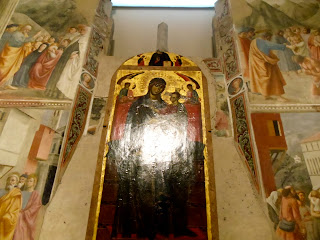
Notice the image in the middle. I apologize for the glare, but the halos are nearly as solid, if not more, than the surroundings. The halos end up conveying the same amount of weight as the bodies and heads they adorn. As our guide termed it, they're like golden dining plates behind their heads." This portrayal of halos starts transitioning in conjunction with a series of corresponding historical occurrences. Near the mid point of the 15th century, there was an ecumenical council between the Roman Catholic powers and the Eastern Orthodox figure heads. This council failed to bring much resolution. In corresponding time the Muslims were finally overtaking the capital of the Eastern Orthodox world, Constantinople. The result shows a back-tracking in the christian West from the traditional conveyance of halos as bearing similarities to those in the Eastern Orthodox church. In conjunction with the somewhat sour council and the invasion of the Turks, the portrayal of saints in Italy visibly began to change. As their clothes began showing a dependance on gravity, as spatial placement and proportions were once more restored in importance for the artists of the Italian Renaissance, so too the halos began to lose their golden solidity. Witness, for instance, the comparison between the prior halos as thick gold dinner plates and the following halo of the upside-down crucified Peter:
It is logically fallacious to draw necessary lines of causality in this relationship, but the correspondence of the rise of humanism and the departure and diminishment of halo-employment is yet worthy of note. Perhaps we see a shift in the artistic understanding of the roles of these biblical figures? Perhaps the thin rim barely perceivable upon the dome of (it's still hard to call him this after my Baptist upbringing: saint) Peter, according to my interpretation, conveys a better understanding of the earthly, secular role of Peter. The other components of this amazing, fire-resistant fresco show the earthbound figure of Peter in many of the acts of Miracles that took place throughout his life after the ascension of heaven. This Saint Peter is seen as a much heavier, earthly, secular-ly figure. The robes draped over his body evince a character fully secular and a part of the earth, leading a life of virtue and purity supreme enough to raise the dead and give the lame the gift of mobility once more through the simple passage of his shadow! It seems then that the rise of emphasis of secularism (i.e. virtue for the sake of virtuous living on this earth as opposed to living for access to heaven) and the capabilities for humanity to and be good here on this earth, i.e. humanism, are expressed in the translation of dinner-plate halos to the thin barely-seen halos present in these frescos and many others like it of the later of the fifteenth and early sixteenth century.
It is significant to recognize that this transition was not instantaneous but a gradual shift, a slow shift from plate halos to thin rims on the head. Perhaps the ultimate portrayal of this can be seen in Leonardo Da Vinci's works, of which very few if not one sole portrayal bears a halo on any saintly figure. Sadly the majority of the locales in Firenze barred us from photography but the picture is so clear in my mind, it's unshakeable. A very European Mary reads a book in a garden as the arch angel Michael pays her a visit (perhaps correlating to an annunciation?). The truly interesting peace is that this bears one of the few halos Leonardo ever crafted. Even in this light, the thin golden bar girding their domes are nothing like their plate-y, physical predecessors. Moreover, this halo was the product of a very young and forced Leonardo, but it was not long after that he held true to his own artistic and theological cogitations. This is perhaps the first and last painting he crafted with any halo involved. A noteworthy bit indeed in a Renaissance world of rising secularism and humanism.
Thursday, June 2, 2011
Tori di Constantine
This is the arch of Constantine near the Roman forum and the Flavian Amphitheater. Thought you guys might like to see me with a smile. Teehee. Pardon the interruption of scholasticism.
Prognostication on Firenze
Somewhere in between the English and Italian languages, i's often shift over to l's. It's been a humorous observation to take place our plazas translate to piazza for Italians, as well as our Florence equating their Firenze. How great! In attempts to project my expectations for the Florence trip I shall employ the aptly assigned materials on Giotto and Brunelleschi, the Renaissance men who truly formed and reformed the heart of the rebirth present in the Renaissance. In the sense of the growing understanding of the Neoplatonists, their work of art was one of the most divine frenzy, representing a most fantastical understanding of the higher forms that art not only becomes but represents. I am most elated to witness the arts these men have produced that have become so crucial to the interworking of the city of Florence for centuries. This focuses most fittingly around the church most popularly referred to as Duomo. This basilica is the birth place of much of the trouble in Brunelleschi's life. Having to contend with Lorenzo to cast in bronze the doors of the baptistry, Brunelleschi lost the competition in creating the most beautiful door, or rather tied with his main contender. Though this seemed as a loss in his eyes, which historically seems to have been for the better. As a result, Brunelleschi ventured to the Pantheon and other famous Roman structures yet extant in the city of Rome to learn their architecture and style. This is what Brunelleschi offered to the Renaissance: a rebirth for the appreciation and application of Roman architecture. The product made possible was the once thought impossible establishment of the dome on the Basilica that remained uncovered for 80 years: the Duomo. Using an ingenious mixture of Roman and Gothic architecture, Brunelleschi was able to achieve what many before him for nearly a century couldn't. Sadly, his newly learned Roman style architecture could not alone solve the problems posed by the necessities of the 180 foot tall towering structure that the Basilica was without the dome! Though he dare not fully cede to the demands for the Gothic style herein, he had to employ some of the techniques for success, though he was able to tickle most of his fancy by employing a sort of dual layered design to establish a successful topping. The result? Something scarcely seen before. Something I can't wait to witness! A combination of art, architecture, mathematics, classical appreciation I can hardly imagine to contest it! And yet, there it is, a testament to the capabilities of Creativity and the true skill of the Renaissance man. Herein lies a clear connection to the kind of scholastic endeavors present in much of Renaissance education--a clear connection to the education of the past. This is a different employment than I am used to, because its medium is not conveyed through text but rather in the sprawling edifices of Italia. Perhaps in absentia from Brunelleschi's work here is the component of secularism; let's face it, all his main works are done for churches. But does he look at it in the same sense that we think of churches? In his ten volume work on buildings, Brunelleschi refers to churches as temples intended for worshiping the gods. His intent is clearly in reference to worshipping God the Father, Son, and Holy Spirit along with the saints but I think there is something being conveyed here that is different than my own more protestant and less Renaissanc-ian thinking on the role of the church. I cogitate often on the purpose of beautiful architecture and the grandiose nature of some cathedrals and usually chalk up to an honor towards God. But there seems to be a different kind of inspiration looped up in this Renaissance thought process, if I may be so bold as to insert my own uneducated opinion. This is a manifestation of a sort of secularist and humanist appreciation for the products of humanity and its capability to achieve the impossible: as in capping the 8 decade-roofless basilica. This is what I am most elated to witness! The manifestation of where Roman meets Gothic architecture, where secularism meets the church, where old meets new in rebirth, where art meets math, where I can limp around the streets of Firenze! In combination with anticipation for Brunelleschi's midwifing in the process of rebirthing Roman architecture, Giotto's astounding rediscovery of the process of proportion and the calculation of distances in painting, sculpting and bronze casting is nothing short of miraculous. It brings to mind a comparison to Plato's departure from the world of forms and contemplation for the re-cognizing of the forms-especially those of good art! Giotto's crafty fingerprints will be all over the city in a way that can scarcely be missed. His reawakening of proportion and detail shows a sort of chronological awareness and Renaissanc-ian appreciation for the education and methodology employed in the past. Certainly the great influences of Brunelleschi and Giotto will bear heavy weight in my appreciation and cogitations in the city of Firenze.
Wednesday, June 1, 2011
Arte a Roma di Michalangelo
Alright, now that I've gotten that butchering of a foreign language out of the way, along with a hectic weekend to the capital of Italy in which I was late to nearly every group meeting (much to my dismay, chagrin, and down right self-loathing for), I experienced centuries, perhaps even millennia of art work! We're talking everything from the Roman Forum to Basilica di San Pietro. I saw the flavian amphitheater! I saw a parade of sculptures, frescoes, 3d-like artwork, and the beauty of the Sistine chapel great enough to illicit tears from Whitney. What do I do with all of this? Out of all these options which could plausibly be selected as most preferable, most exemplary, most favored among the Renaissanc-ers? All superlatives and fictitious words aside, I turn to Michael Angelo's depiction of Constantine's war in which he invokes the name of Christ and victoriously alters the face of Christianity for ever more: taking what was once peaceful for war, what was once for the outcast for the mainstream, what was once opposed to much of the Roman Empire for another piece of architectural underpinning to be subsumed by the non-stop automaton of the Roman civilization. Judgment's over! Thanks for allowing me a Protestant aside. Check the painting out! Pretty beautiful right, at least if we ignore the extreme examples of violence portrayed therein. My picture can do no justice to the form of this art! It's but a mere imitation of a gloriously done imitation. To truly appreciate this you would need to visit Musei Vaticani or at least borrow a book from me on the place! But please, tickle my fancy. Just ride with me on my shoddy attempt at deciphering just what the artist intended with the original. We see the clear focus on the ideal form of what humanity should be, each muscle strengthened, proportioned, balanced, and aesthetically pleasing. If you can notice, the water here is not even splashing around the people as they fall, slain in battle. Is this a lack of focus on detail or more a focus on the human beings of the picture? I like to believe that it is simply focusing heavily on the peoples as opposed the background surroundings.
As a quick side note: The balance in this piece is clever in recognition of the split between the sky and the ground and the battle scene in contrast to the body of water in the left corner creates an off center, yet oddly balanced piece. I also assume the man in shining gold armor to which most items point towards is Constantine himself and perhaps the angels above him, though even they point down back towards Constantine's advance. This certainly may be my own assumption but the armor that these people have donned looks a little more recent than the armor I would expect to see in the fourth century CE when the battle took place. There's also a pretty stark absence of Imperial Roman paraphernalia, which might be a sort of reclaiming the historical item and renaming it utterly in Christian will as opposed to its probable basis in somewhat muddled mixtures between Roman interests and Christian ideals. It is also fascinating to me that Constantine himself does not have blood on him or his weaponry as far as I can tell. This may entail a certain amount of virtue associated with him, if I am not reading into this too much, in that he is not blood thirsty but also not afraid of battle. This kind of reaches back to some of the Aristotelean ideas of virtue in attempting not so much to produce a kind of fool hardy-cocky at one extreme or an inferior cowardice, but the Aristotelean approach boasts a kind of balance between the two that Constantine seems to be boasting (a sort of anachronistic combination I imagine would be heavily shot down in modern society's understanding of proper order). This is very common in the Renaissance works we have thus far observed. The kind of focus that is present here just screams Renaissance in so many ways it's truly hard to miss.
Subscribe to:
Posts (Atom)
